Categories
News and Views

Ideology, Authoritarianism and War

Independence Day 2026

PREFACE

Otto Kernberg’s “Ideology, Conflict and Leadership in Groups and Organizations” (1998), is a masterpiece of Freudian analysis of Mass Psychology. This work provides the intellectual framework of this article. I have augmented sections of this synopsis with ideas extracted from Herbert Marcuse’s “Eros and Civilization” and “One-Dimensional Man”, Wilhelm Reich’s “Mass Psychology of Fascism”, and R.D. Laing’s “The Politics of Experience.”

***

BACKGROUND

Sigmund Freud’s view of human psychology divides the personality into three interacting components: the id (instinctive desires demanding immediate gratification), the superego (the moral conscience which embodies societal norms, rules and prohibitions) and the ego which seeks to balance these drives.

In “Civilization and Its Discontents” (1930) Freud argues that human unhappiness stems from the conflict between individual instinctual drives (libido / aggression) and civilization’s demands for repression, which forces conformity for security. Civilization requires denying instincts which causes unhappiness but is regarded as a necessary compromise – “the pleasure principle” is thus superseded by “the reality principle.”

Herbert Marcuse argues that the reality principle has been perverted by capitalism into what he calls “the performance principle” which further negates libido, regarded by Marcuse as life affirming. Marcuse argues that under Capital’s “logic of domination” the individual exists as a thing, a reified entity whose sole purpose is to serve the State. Sexual activity is confined to the genitals in order to produce more workers and soldiers. Conformity is rewarded with the “gadgets of affluence”, technology that further entraps the individual.

“The performance principle, which is that of an acquisitive and antagonistic society in the process of constant expansion, presupposes a long development during which domination has been increasingly rationalized…”
— Herbert Marcuse

The end result is the individual has become “one-dimensional”, speaking in internalized cliches and seeing the world as a hostile and empty place. Marcuse also argues that the individual has internalized the belief that Capital is the be-all and end-all, the highest possible point of human societal development. This ideology – there’s no way like the American Way – is seen as “reality” rather than a belief system, rather than as an ideology. But the repression of libido causes psychic distress and unhappiness often to the point of longing for death. Many who embrace the internalized ideology, at least superficially, seek relief from frustration and despair.

Right wing populist, e.g. authoritarian, leaders promise change, promise a unified community, a Volksgemeinschaft that excludes a scapegoated minority and facilitates a return to (a largely mythical) “greatness.” The scapegoat can be a group of individuals (racial or religious) or a nation state. In the latter case war is often the outcome. The out group is said to be victims of a false consciousness, an ideology. Marcuse argues that every group has an ideology but victims of the performance principle deny this for their group…they alone see what they call reality.

Why do people blindly follow authoritarians? Kernberg argues that they escape from the repression the superego enforces by “projecting their superego” onto an idealized leader.

MASS PSYCHOLOGY

Renowned psychoanalyst Otto Kernberg argues that subordinate members of a group or organization feel relieved of responsibility by projecting their ego ideal (superego) onto a group leader. This allows the group to “follow the idealized leader [ of the mob ] blindly, as described by Freud”, which “reconstitutes a sort of identity by identification with the leader, protects the individual from intragroup aggression by this common identity and the shared projection of aggression to external enemies, and gratifies dependency needs through submission to the leader.” According to Kernberg, regression is inherent in the group process, the mob being the most exaggerated form. This dynamic was evident in Germany’s National Socialist period and today in the US with the MAGA movement.

“I could stand in the middle of Fifth Avenue and shoot somebody and I wouldn’t lose any voters.”
— Donald Trump

Kernberg argues that regression in groups is omnipresent, as described in Freud’s studies of ‘mass psychology’. While the regression is most severe in the unstructured mob (gangs, lynch mobs, etc.) it is present in any group where the individual’s identity, moral code, ethical imperatives, etc., are diminished due to projection of the ego ideal (or superego / sense of personal responsibility) onto the idealized leader.

“The group becomes a machine and that it is a man-made machine in which the machine is the very men who make
it is forgotten.” — R.D. Laing, The Politics of Experience

IDEOLOGY

“The social value of the individual is measured primarily in terms of standardized skills and qualities of adjustment rather than autonomous judgment and personal responsibility.”
— Herbert Marcuse, Eros and Civilization

The glue that holds every group together is ideology. In the case of an authoritarian movement the ideology is provided by a leader who offers simplistic solutions, scapegoats and soothing, conventional cliches.

National Socialists were very conspicuous for their skillfulness in operating upon the emotions of the individuals – avoiding relevant arguments as much as possible.
— Wilhelm Reich, The Mass Psychology of Fascism

Even when an authoritarian structure appears benign, the leader imbues followers with a group ideology that often reduces thought to cliche and demands conformity. What’s more the benign structure is not necessarily static: “The ever-present dangers of ideological regression and bureaucratic sadism cannot be overestimated.” (Kernberg)

Marcuse defined ideology as “Officially desired and advertised attitudes.” He also pointed out that most Americans believe they don’t have an ideology. The US is the “Land of the Free” where citizens are regarded as consumers and commodities first and foremost but view this as the natural order of things. Any other viewpoint is regarded as alien – and simply wrong. The State rewards “one-dimensional thought” (conformity and non-critical thinking) with a relative affluence and the “gadgets of affluence.” Technology is used as a form of social control. People will sleep on the sidewalk in order to obtain a new iPhone but will not join a protest to stop an unjust war or to demand healthcare.

One-dimensional thought is systematically promoted by the makers of politics and their purveyors of mass information.
— Herbert
Marcuse, One-Dimensional Man

Ideology is the glue but what is the ultimate outcome? Reich calls it “national narcissism.” “There’s no way like the American Way” was a popular slogan in 1937. It is still accepted as fact.

This inclination to identify [ as a group member ] is the psychological basis of national narcissism.
— Wilhelm Reich, The
Mass Psychology of Fascism

And national narcissism is a fertile breeding ground for authoritarianism.

SURPLUS AGGRESSION

In any group the phenomenon of “activated mass psychology” — projection of the ego ideal — grants the leader quite a bit of power over the group and its members. This idealization corrupts its object: “When socially determined excess of power is vested in the leadership, or a historically determined excessive power vested in the leadership transforms functional authority into authoritarian power, the conditions are ripe for misuse of such power in the discharge of surplus aggression, which can have a paranoiagenic effect.” (Kernberg)

Surplus aggression refers to heightened, often violent behaviour which can be driven by social constructions of masculinity, economic opportunity (or lack thereof) and political structures.

“Paranoiagenic” refers to the theories of Elliott Jacques, adapted by Kernberg. Jacques (1976) described two types of organizations: requisite (where authority and accountability are matched) and paranoiagenic. Paranoiagenesis is an organizational process (of regression) characterized by fear, mistrust and hyper-alertness. It results from the development of an unsound administrative structure. According to A. Kenneth Rice, regressive group processes triggered by unsound authoritarian structures or leadership produce an “institutional paranoid group” reaction.

In an authoritarian, paranoid, environment surplus aggression can be channeled into acts of violence one of which is bureaucratic sadism.

BUREAUCRATIC SADISM

Bureaucratic sadism is the intentional infliction of psychological pain and humiliation through the rigid and arbitrary application of rules and regulations. It is a phenomenon associated with psychopathy and narcissism. It can also be associated with Borderline Personality disordered individuals who “split.” Splitting involves seeing only black and white, no shades of grey. And what is black one day can be white the next and vice versa. An authoritarian leader deprived of narcississtic supply by a subordinate may regard the previously esteemed subordinate as a threat (to ego) and respond with bureaucratic sadism.

Kernberg argues that authoritarian structures tend to abuse their power, discharging surplus aggression and indulging their bureaucratic sadism. Often the idealized, authoritarian, leader remains in control because it is not recognized that the problems generated by authoritarian actions and environments originate with the leader.

Kernberg’s group theory builds on the work of Wilfred Bion, who theorized that most groups fall into three categories: ‘pairing’, ‘dependency’ or ‘fight-flight’. While the “pairing” group is relatively functional and non-paranoid although it is utopian in that it presupposes that two “paired” members or a paired member and idea will provide security through group identity and ideology, Kernberg argues that dependency based groups seek a calming, narcissistic, reassuring mediocrity for a leader, what psychoanalysts Didier Anzieu and Janine Chasseguet-Smirgel described as a pseudopaternal “MERCHANT OF ILLUSIONS” — a vendor of ideology composed of “conventional cliches” (Kernberg). The pairing group fails to address pressing issues because of its culture of hope. The dependency group can become a “fight-flight” group due to regression that can originate with the narcissistic leader – or the group itself.

Regarding the Merchant of Illusions, Wilhelm Reich argued that “It is in the nature of a political party that it does not orient itself in terms of truth, but in terms of illusions, which usually correspond to the irrational structure of the masses…Social leadership consolidates regression if it: tries to pass off the regression as progress, proclaims itself to be the savior of the world, and shoots those who remind it of its duties.”

According to Kernberg: “primitive idealization, projected omnipotence, denial, envy, and greed, together with their accompanying defenses, characterize the basic dependency group. These groups are conventional, ideologically simplistic, conformist, and able to indulge themselves without guilt or gratitude; they lack a sense of personal responsibility or a deep investment in others.”

Describing the paranoid mindset of the fight-flight group, Kernberg states that “The second basic-assumptions group operates under a “fight-flight” assumption, united against what it vaguely perceives to be external enemies. This group expects the leader to direct the fight against such enemies.

The dependency group can become a fight-flight group when group regression triggers regression in the leader (prompting a “sudden exertion of authority” — authoritarian acts) which can contribute to a paranoid environment in which the fight-flight group flourishes.

INSTITUTIONALIZED DEHUMANIZATION

Projection of aggression onto an external enemy often results in institutionalized dehumanization of the out-group, providing the in-group with a cohesive force. Institutionalized dehumanization is a technique of control, whether orchestrated or unconscious, that is effective in keeping the authoritarian leader in power. The most extreme example would be a genocidal situation in a nation-state.

The Nazis used Jews as a scapegoat, an “external enemy”, MAGA targets migrants who are often selected for arrest based on skin colour and presumed national origin, people characterized by Trump as “murderers and rapists.” Bureaucratic sadism is evident in both instances. While more extreme in Nazi Germany, the Trump administration’s sending of arrestees to the notorious CECOT prison in El Salvador, without any semblance of due process, is another example of bureaucratic sadism. The conditions at the “Alligator Alcatraz” detention center in Florida were overtly sadistic which resulted in rare public outrage and the closure of the facility, likely because it was on US soil..

Authoritarisn control of a group is also facilitated by what Kernberg calls PSEUDOHUMANIZATION. Kernberg argues that leadership devoid of moral justification is based primarily on power: members are controlled by manipulation and “pseudohumanization” of the interpersonal relationships and working conditions — individual moral imperatives are redefined in service to the group. For example, the value of a group member is measured by performance alone. In a situation where pseudohumanization exists (e.g. where an authoritarian administration coexists with paranoid group regression) the performance evaluation supersedes individual values / belief systems in the mind of the member. This complements the elimination of personal responsibility accomplished by projecting the superego onto the leader.

Stanley Milgram’s classic Obedience to Authority experiments demonstrated how pseudohumanization could be induced in ordinary citizens by having an individual in a white lab coat tell them to continue administering electrical shocks to a unresponsive test subject by simply saying “the experiement requires that you continue” and “treat no response as an incorrect response.”

An infamous example of the subordinate as sociopath is Adolf Eichmann, the SS officer who was the chief architect of the Holocaust and whose greatest regret is that he never got promoted to Standartenführer (full Colonel). He was quoted by Hannah Arendt (Eichmann In Jerusalem: The Banality of Evil) as apologizing to the Israeli court for his poor German with: “Amtssprache ist meine einzige Sprache.” (I only
speak bureaucratese.)

OF SERVITUDE AND SADISM

“This is the pure form of servitude: to exist as an instrument, as a thing.”
— Herbert Marcuse, One-Dimensional Man

Narcissistic leaders also tend to hamper the efforts of effective subordinates, sometimes by design: “The more severe the leader’s personality pathology and the tighter the organizational structure, the greater the destructive effects of the leader on the organization. The reduction in the authority of functional leadership reduces the clarity of task systems, [ and ] weakens leadership functions throughout the organization.” (Kernberg)

Pardoxically, despite the desire to avoid the appearance of failure(s), the authoritarian leader will protect select incompetent subordinates, especially sycophants and yes-men: “At times strong and authoritarian, even sadistic, leaders have shown a weakness for an incompetent subordinate even while acknowledging his failings. There may even be an undertone of satisfaction (or moral self-congratulation) in the tolerance of this person in the face of complaints about his incompetence.”

Of course non-compliant subordinates, or those who fail to flatter, may be dismissed or become part of an out-group.

Some “groups may become intolerant of individuals, establishing a group dictatorship that acquires characteristics of a primitive morality and fosters the leadership of narcissistic and antisocial personalities.” (Kernberg)

NARCISSISTIC LEADERS

“Any group, small or large, tends to select leaders who represent not the paternal aspects of the prohibitive superego but a pseudopaternal merchant of illusions. A leader of this kind provides the group with an ideology, a unifying system of ideas; in this case, the ideology is the group as a primitive ego ideal, basically, the small or large group members’ identification with one another permits them to experience a primitive narcissistic gratification of greatness and power.” (Kernberg)

“Of all the character pathologies of leaders that endanger institutions, narcissistic personality features are perhaps the most serious. I must stress that I am using the concept of narcissistic personality here in a restrictive sense, referring to persons whose interpersonal relations are characterized by excessive self-reference and self-centeredness; whose grandiosity and overvaluation of themselves exist together with feelings of inferiority; who are overdependent on external admiration, emotionally shallow, intensely envious, and both disparaging and exploitative in their relations with others.” (ibid)

“The narcissistic leader’s aspirations center around primitive power over others, the desire for admiration, even awe, and the wish to be admired for personal attractiveness, charm, and brilliance, rather than for mature human qualities, moral integrity, or creative leadership…Since narcissistic leaders tend to surround themselves with yes men and shrewd manipulators who exploit their narcissistic needs, more honest and therefore critical members of the staff are pushed aside.” (ibid)

“The inability to form mature judgments about people and the reliance on sycophants reinforce each other and can lead to to a situation in which the narcisstic leader is surrounded by people similar to himself, people suffering from other serious behavior disorders or cynically exploiting their awareness of his psychological needs.” (ibid)

MALIGNANT NARCISSISM

“The most extreme form of paranoiagenic leadership is represented by leaders whose personality is characterized by malignant narcissism — that is a narcissistic personality combined with ego-syntonic sadism, paranoid tendencies, and antisocial features.” (ibid)

The end result of malignant narcissism in authoritarian leaders is often war. Historically, it starts with the oppression of an out-group. But if an out-group can be expanded to include an external enemy war will provide narcissistic supply to the leader and distract from other issues (e.g. the Epstein sex trafficking scandal). Trump’s attacks on Venezuela and Iran appear irrational but there may be method to the madness as well as narcissistic supply: profits for the permanent war economy as well as distraction from domestic issues.

“If there is no external danger, then danger and terror have to be invented and maintained.”
— R.D. Laing, The Politics of Experience

“The mechanical, mystical, and authoritarian organization of human society and of the human structure constantly precipitates the mechanical destruction of human lives in war.”
— Wilhelm Reich, The Mass Psychology of Fascism

RESISTANCE

The rule of law is defined by the ruling elite. And when the law is broken by the elite there are no consequences. Donald Trump was convicted of 34 felonies and yet was re-elected president. This can make resistance to authoritarianism very difficult.

“The fact that the affluent warfare state unleashes its annihilating potential on the backwards countries illuminates the magnitude of the threat of anyone challenging their hegemony by not pursuing overproduction via technology.”
— Marcuse, One-Dimensional Man

“The system has its weakest point where it shows its most brutal strength: in the escalation of its military potential (which seems to press for periodic actualization with ever shorter interruptions of peace and preparedness).” (ibid)

“A colonial war which takes place at the margin of the civilized world…is practiced with good conscience for war is war.”
— Herbert Marcuse, One-Dimensional Man

“The lives of courageous American heroes may be lost and we may have casualties. That often happens in war.”
— Donald Trump, February 28, 2026 after attacking Iran

Marcuse noted that “Opposition to war and military intervention requires something that is much harder to produce – the spread of uncensored and unmanipulated knowledge.”

If we can stop destroying ourselves we may stop destroying others. We have to begin by admitting and even accepting our violence, rather than blindly destroying ourselves with it.
— R.D. Laing, The Politics of Experience

CONCLUSION

Americans like to think that we don’t have an ideology which of course is proof that we do. We also like to believe our government is not authoritarian. And that we don’t wage aggressive wars, we are freeing people in other countries. And so it goes.

Reality is that which, when you stop believing in it, doesn’t go away.
— Philip K. Dick
Categories
News and Views

TAG, I’m It


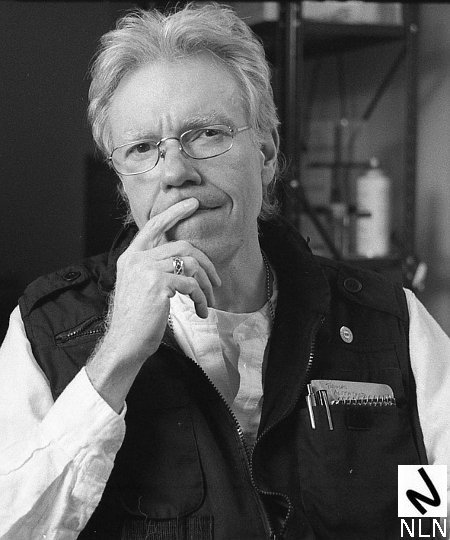
TAG, I’m It – Self Portrait, 2010
(Photo: Thomas Good / NLN)

May 28, 2010 began innocently enough — but by mid-morning I found a woman I hadn’t seen in over 50 years.

“The Conversation” took place early in the day. It was a Friday that seemed ordinary enough. But it would turn out to be truly remarkable.

“Hello, can I speak to Sandra?”

“This is Sandra…”

“Hi, my name is Thomas Good and I have reason to believe that I might be your son.”

***

I am a Leo, born in mid-August. But my mother says that I have a new birthday, that I was reborn on the day she and I were re-united after a 50 year separation: May 28th. So, like George Washington, I celebrate two birthdays. We are party animals, George and me.

Whenever I think about how it felt to find my mother — and to discover my family history — I am astounded.

***

The phone call, “The Conversation,” happened after a long search.

When I was very young, my adoptive mother told me that I was adopted and that my birth name was “Altfather.” She told me that my family came from the German part of Pennsylvania and that my mother was an artist. I studied art and German as a kid in an attempt to embrace my roots. Years later I went to the “Heimat” (homeland) for the first time. It was 1996 and I was in Rotterdam on business. Seizing the opportunity, I jumped on a train to Düsseldorf. As the sun rose I traveled from Appledorn to Emmerich, crossing the Dutch frontier. At the border the Dutch train crew departed and their German colleagues came on board. The rising sun illuminated the steel rails and I exhaled slowly. It was almost impossible to believe that I had finally arrived in the ancestral homeland. Everywhere I went in Düsseldorf, I met people who were very excited that a son of Germany had returned home. “Inspiring” would be an understatement. And so, in 2000, I took my wife and young son to München. I was visiting a colleague and took the opportunity to show my family a little bit of Germany. After landing at the airport we went through customs. Stamping my passport, the German border guard looked up when I said, “Schönes Tag.” For whatever reason he got very excited and came out of his booth to shake my hand. I have no explanation and no words. Another ethereal experience. Another one of Andre Breton’s “surreal Moments.” Life should be about joy, it should be celebrated. I don’t know that official’s name but I am grateful. Whatever else we are, we are both somebody’s son.

A few years later I discovered that, although they had sealed birth records in 1964, the great state of Ohio allowed people born prior to 1964 (or after 1996) to access their original birth certificates (http://www.odh.ohio.gov/vitalstatistics/legalinfo/adoption.aspx). On my 51st birthday I mailed in my application and the filing fee, expecting little – I already possessed the documents my adoptive mother had given me before she died. A month later my original birth certificate arrived. I felt like a kid getting a decoder ring. On it was my birth mother’s name. And her home town in Pennsylvania: Berlin. Two valuable clues. I searched via google for Altfathers from Pennsylvania — as I had already done many times. But this time I zeroed in on Berlin. I would repeat this search innumerable times in the coming weeks. Not much came up. But everything changed on May 28.

On a quiet Friday, sitting at my desk sipping some coffee and preparing to get to work, I googled one more time, expecting nothing from the familiar exercise. And then I got a lead. A break.

I never met Bill Altfather – he died in 1998. But a woman in South Carolina had posted his obituary on a genealogy website. The obit listed the surviving relatives. My mouth fell open when I discovered that one of the survivors was a woman whose maiden name was very familiar. It also gave her married name. That was the missing piece that tied things together neatly. And from there I found a viable phone number.

***

I “met” my mother in July of 2010 — we had met once before — when my family and I journeyed to her home. I can’t help but cry as I type. The first look, the first hug. Beyond words. Imagine what it means to be a complete human being and you’ll have an idea of what it feels like.

Unfortunately there is a political reality that many adoptees encounter when researching their past. Far too many states block adoptee access to what are known as “Original Birth Certificates” — or “OBCs” in the adoptee rights movement. There is no national standard and “States Rights” means that, in many states, adoptees have no rights to access their own birth certificates. Imagine your doctor saying, “Is there a history of diabetes in your family?” and you have to reply that you have no way of knowing. Imagine you spend your entire life not knowing the circumstances around your adoption. Imagine you can’t recall what your mother looks like? Imagine an impersonal response from a state official.

What is to be gained from blocking access to OBCs? Statistics show that birth mothers overwhelmingly embrace their long lost offspring when reunion occurs. And adoptees like yours truly don’t feel any need to turn their backs on those who raised them. Family is not an either/or scenario. The bottom line: adoptees are not the property of the State. We have rights and it is time that they be respected. Adult adoptees are as capable of making their own decisions as any other citizen is. There isn’t any rational reason adult adoptees should be second class citizens.

Sadly, New York State lags behind Ohio in respecting the civil rights of the adoptee. Sealed adoption records leave individuals searching for birth parents with only one recourse: a state-run adoption “registry” that can help facilitate a reunion. But there are no guarantees as one woman’s story reveals. According to the Utica Observer Dispatch, Kelly Wittman Clausen, a 37-year-old adult adoptee, has been on the registry since she was 21 — and has yet to find her mother.

Except for an accident of birth, I would not have found my mother. By sheer luck, being born in Ohio rather than New York — or Pennsylvania — I had access to my original birth certificate. My mother cried when I called her. And when I apologized she said, “These are not tears of sadness.”

***

When I visited my mother in July I spoke to her about an idea I had. I had decided that, on the occasion of my 52nd birthday, I would rectify what I had come to regard as an error. Mom smiled and said, “So you’ll be ‘TAG’.”

When I was barely two months old I had been given a middle name by my adoptive family — the surname of a distant relative whom I had never met. As my adoptive parents were both dead by the time I found my birth mother I made a unilateral decision. With the assistance of my friend and occasional attorney, an amazing National Lawyers Guild member named Gideon, I petitioned the State of New York for a name change. I filled out several forms, got my wife’s permission in writing, got everything notarized and filed my papers at the civil court. When it came down, I took the judge’s decision to the local newspaper for publication. The technicalities completed, I procured new ID. Once the process was finalized — it took about two months — I was a hybrid. My first and last where the names I had been given upon adoption. And sandwiched in between was what I jokingly referred to as my “maiden name.”

The change is no small matter.

With the exception of my middle name, I kept my adopted name(s). I am grateful to my adoptive family and the name they provided was, by and large, a good fit. But with the new middle name I feel complete, whole — part of an extended family.

I had no control over decisions made at the time of my birth and so it is gratifying that I will die as what I am – an Altfather, as well as a Good. It is my decision and one I am very comfortable with. I like to tell people “TAG, I’m it.”

I believe that every adoptee has the right to know their past, to find their birth parents and reunite – if the adoptee and the parents wish to do so. It is the right of any human being to possess their history, to define themselves, to make their own decisions.

The process is hard enough without the state interfering — I was scared shitless at several points along the way. I felt some guilt. I felt some frustration, some remorse. But throughout, I felt joy. Everyone should have the opportunity to discover who they are and where they came from. Our past is our property.

I am proud to be reborn as my mother’s son. TAG, I’m it.

Happy New Year to all of the adoptees and ALL of their parents.

Thomas Altfather Good,
New York City
December 31, 2010

“All of my days, all of my life, standing by you — all of my days, all of my life, I will find you.” — Cyndi Lauper, “Echo”

Categories
News and Views

Voices Of The Forgotten


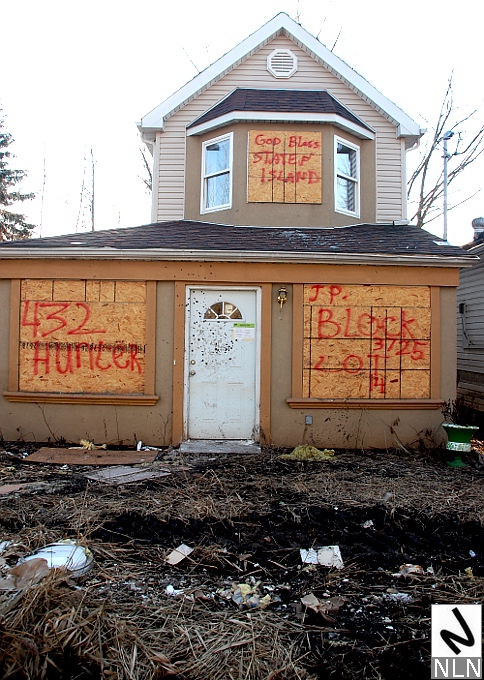
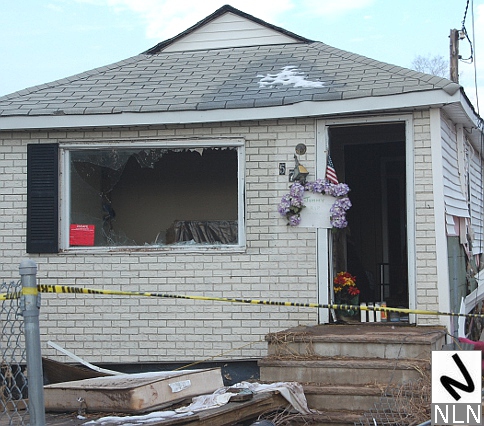
A house on Hunter Avenue, Dongan Hills, Staten Island.
(Photo: Thomas Altfather Good / NLN)


STATEN ISLAND, N.Y. — January 2, 2013. Journalists don’t often get thanked for requesting an interview — especially when they interrupt someone’s holiday — but on New Year’s Day a Sandy survivor named Elizabeth Hession said to this reporter, “Thanks for caring.”


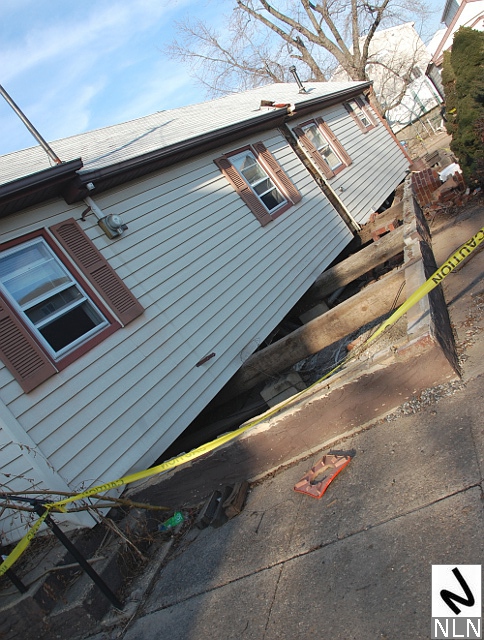
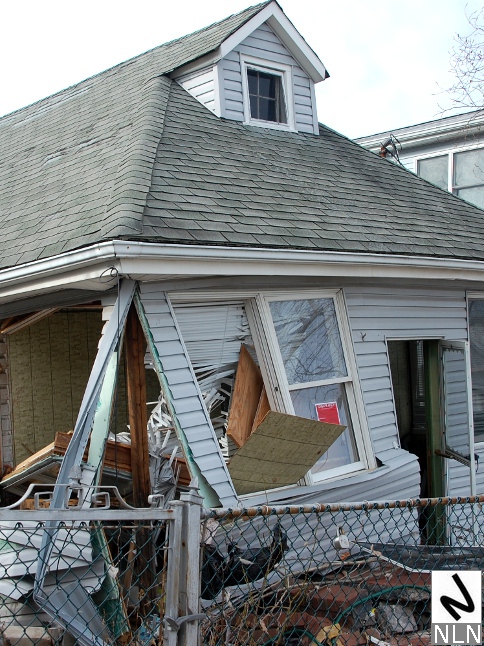
Another Hunter Avenue home, knocked off its foundation by Sandy.
(Photo: Thomas Altfather Good / NLN)

 
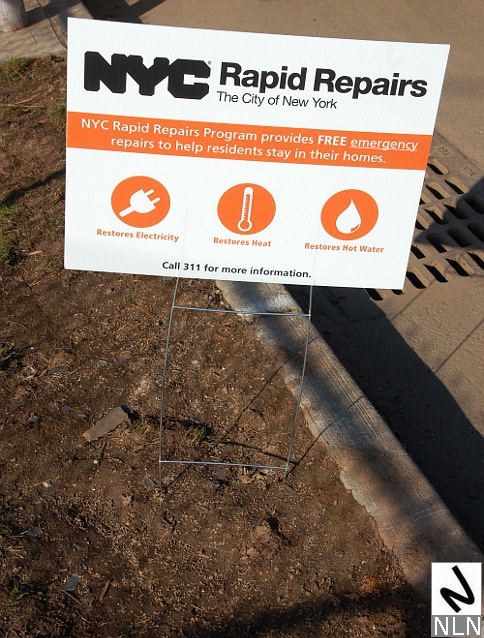
RAPID REPAIRS?

 
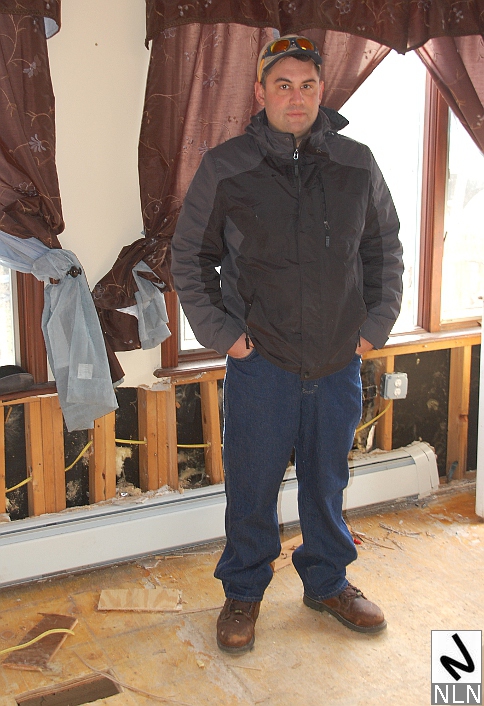
Liz Hession owns a home on Hunter Avenue in the Dongan Hills section of Staten Island. Her street was particularly hard hit by Hurricane Sandy. On the night of October 29, the 60-year-old Staten Islander stared out her window in disbelief as a wall of water roared down the avenue. She and her husband, their dog, and four birds ran for the attic. 12 hours later, they were rescued by first responders in a rowboat. The Hessions were deposited on Hylan Boulevard, in three feet of water. They were eventually located by their daughter who took them to shelter. Two of the birds died but the soaked and stunned Hessions survived Sandy. Three days after the storm, they returned home. Sandy’s flood waters had done considerable damage. Hession’s 71-year-old husband, Jim, gutted their home, cleaning the affected areas with a bleach solution, as the couple awaited the arrival of New York City’s so-called “Rapid Repairs” program. It never came.


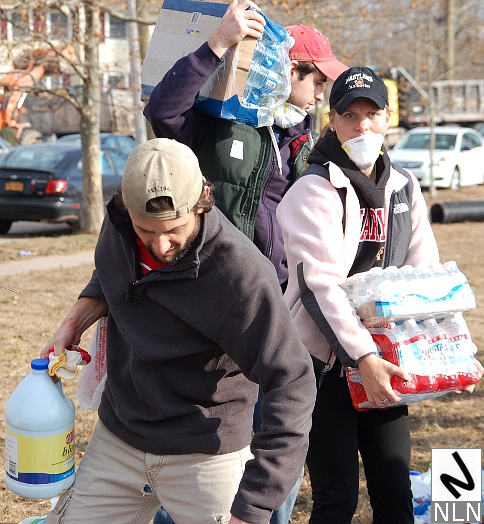
Volunteers from the University of Maryland delivering supplies in Midland Beach.
(Photo: Thomas Altfather Good / NLN)

 
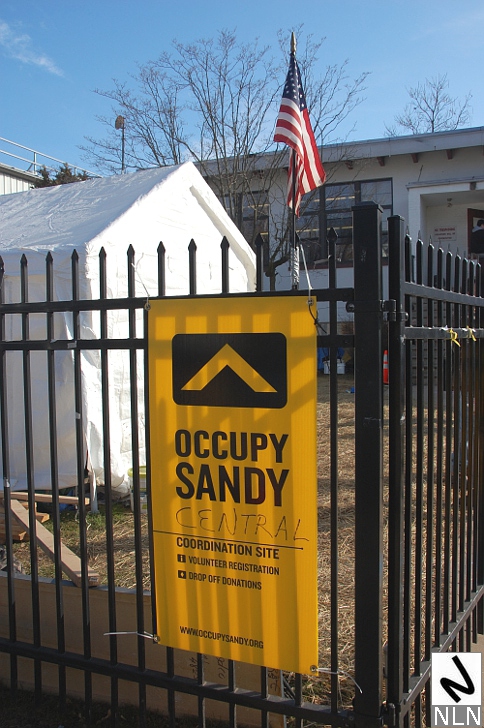
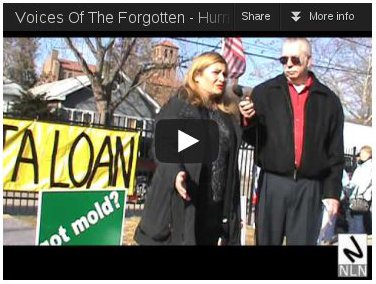
On December 15, Liz spoke out at a forum organized by Occupy Sandy — the all-volunteer community based relief effort that maintains a “hub” in Midland Beach, not far from the Hessions. She questioned what the Red Cross was doing with all of the donations it had solicited on television and the internet.


Volunteers are the backbone of the relief effort in hard hit Midland Beach.
(Photo: Thomas Altfather Good / NLN)

 
“I heard that people were contributing billions of dollars throughout the world, not just in the United States, not just in New York. Text something on your phone to contribute ten dollars to the Red Cross because they’re gonna be there, they’re gonna help,” she said.


The final resting place of James Rossi, 85-years-old.
(Photo: Thomas Altfather Good / NLN)

 
“Where is all that money,” she asked, “I want to know where that money is right now,” she said as the audience cheered.


The gutted home of Slava Viner, Midland Beach
(Photo: Thomas Altfather Good / NLN)

 
“What I need is contractors coming in and helping us. And they’re not there. Rapid Repairs, we applied when they first came out. It’s already six weeks we’re waiting for Rapid Repairs,” she said.


Rapid Repairs?
(Photo: Thomas Altfather Good / NLN)

 
Two weeks later, on New Year’s Day, Liz Hession told NLN that the only contact she had with Rapid Repairs was a phone call. A program representative had called her a few days earlier to ask if she was satisfied with the repairs effected by the City — repairs that never happened. Hession told the rep that no repairs had been done. The representative apologized and promised to get the Hessions help. Three days later another Rapid Repairs rep called, asking Jim Hession if he was satisfied. He wasn’t and he let them hear it. As of January 1, Liz Hession and her husband were still waiting for a site visit from Rapid Repairs.

 
“Nothing’s changed, it’s gotten worse actually, because they’re all screwed up over there,” she said.

 
The Hessions were “lucky” — a relative concept for Sandy survivors. They did receive $31,900 from FEMA, the maximum amount. Liz doubts that it will cover all their losses. Their home sits on a four foot concrete slab. But the house filled with seven feet of flood water — Liz said that an 11 foot storm surge hit Hunter Avenue when Sandy came ashore. The home was wet for three days and like other survivors the Hessions had a serious mold problem when the water receded. Although they used a FEMA-recommended bleach solution to kill the mold, a drenching rain in late December, and no infrastructure repair — no electricity to run a dehumidifier, could wash away their efforts at mold remediation.

 
“My husband did clean the mold out. But whether it’s grown back because it’s been rainy and damp and we don’t have any dry heat [ or electricity ] to run the dehumidifier or anything like that, I’m not sure. When we get back in the house, we’ll know,” Liz said.

 
Mold remediation is both a serious health crisis in the making and a metaphor.


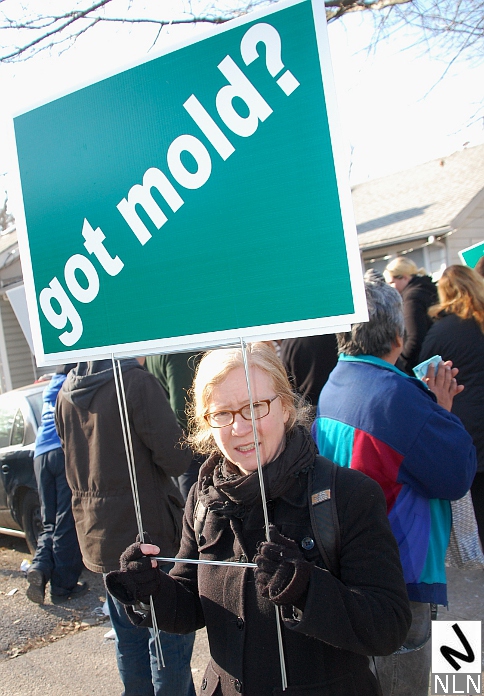
Got Mold?
(Photo: Thomas Altfather Good / NLN)

 
GOT MOLD?

 
The official relief effort has been marred by double binds and catch 22 scenarios. FEMA will not pay for mold remediation — and most reputable contractors want cash up front. Rapid Repairs provides a free boiler and restores electricity to battered homes but their workers will not enter a dwelling if they find that mold is present.


Health care worker — and Midland Beach resident — Lyn Governale.
(Photo: Thomas Altfather Good / NLN)

 
Addressing participants at the December 15th Occupy Sandy community speakout, Midland Beach resident Lyn Governale described the problem.


The interior of Governale’s home.
(Photo: Thomas Altfather Good / NLN)

 
“My neighbors lived in their house for 30 years — they can’t come back. Just so many people feel like they don’t know where to turn, they don’t know who to turn to. Insurance companies aren’t coming through for us. FEMA has been minimally helpful. I see my neighbor rebuilding her house — with mold in it. And she just thinks she has to just keep going,” an emotional Governale said.

 
“We need help out here,” she added.


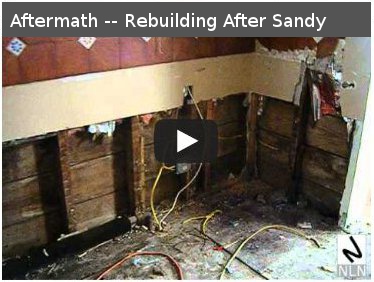
Click to hear Sandy survivors speak out. (Video)


Waiting for the insurance company…
(Photo: Thomas Altfather Good / NLN)

 
IN GOOD HANDS?

 
Angela DeSanno wasn’t at home when Sandy came calling. The social worker was on vacation — stuck on a cruise ship with no way to get home.

 
“I was on the phone with my family — my son, daughter and mother — through the storm until the phones went dead,” DeSanno told NLN.

 
DeSanno’s mother, who lived in the lower level of the Mother-Daughter house, knew that the family home was in Zone B and therefore, according to the Mayor’s office, they didn’t need to evacuate.

 
DeSanno’s son Anthony had bought all the recommended items — water, batteries, tape for the windows — and reassured his mother that everything would be fine.


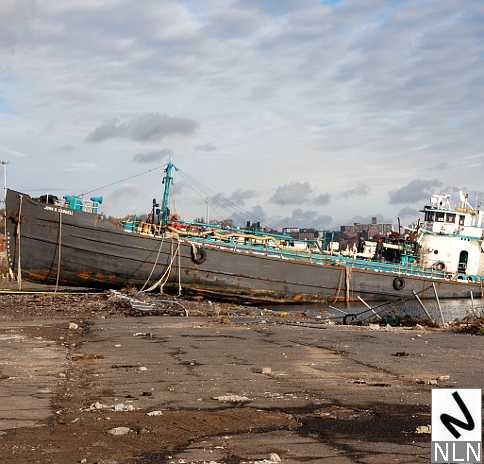
A 185′ water tanker parked on Front Street in Clifton, Staten Island.
(Photo: Thomas Altfather Good / NLN)

 
“The night of the hurricane was kind of weird. We were all on the phone and my mother kept saying that it was barely raining. She said that she thought the weather reporters got it wrong again! She kept saying that she was going downstairs to go to bed,” DeSanno said.

 
“When I moved to Staten Island from Brooklyn 25 years ago, the realtor told us the house was considered a Mother-Daughter. She said that our home was a little more expensive than others that were similar because we were ‘above the Boulevard.’ Coming from Brooklyn, I had no clue what that meant. Apparently, you don’t have to worry about flooding or water in your apartment when you live above the Boulevard. Through all the years that we have lived here, we never had an issue. My mom’s apartment never got any water during storms,” she said.


A storm-damaged car: water inside, seaweed in the grille.
(Photo: Thomas Altfather Good / NLN)

 
This changed on the night of October 29. Brittany, Angela’s daughter, looked out the window of the second level, concerned about wind damage. She saw cars going down the block at high speeds — in reverse. DeSanno’s kids woke their grandmother and brought her upstairs. Within minutes the back doors of the house were blown out by a massive surge of water. The grandmother’s apartment filled with flood water and the second floor apartment also took in water.


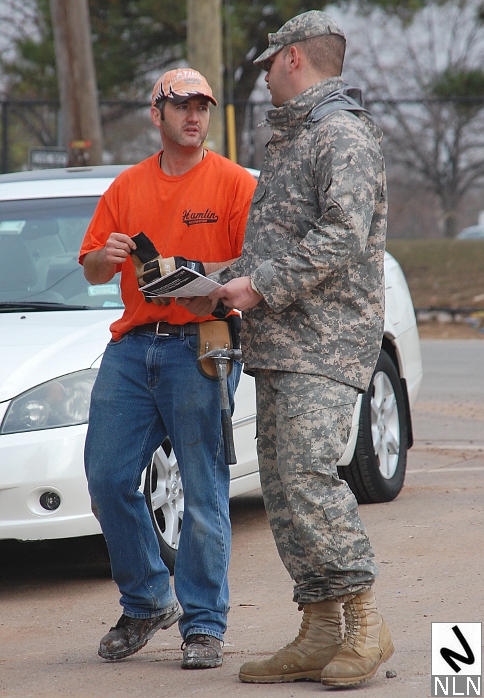
A grunt hands a nyc.gov flier to a homeowner in Midland Beach.
(Photo: Thomas Altfather Good / NLN)

 
“My family was trying to call 911 but was unable to get through. At that point, my contact with them ended as the phones went dead. My family was rescued that night by the Coast Guard — with boats! My mother was taken to Staten Island University Hospital with chest pain and my kids slept on the floor of the hospital with wet clothes. The hospital was having problems of their own,” DeSanno said.

 
DeSanno lost the use of her mother’s badly damaged apartment and all of its contents. The family lost their cars, furnace, hot water heater, and electrical panel. The second floor apartment was damaged but the family remained there, without heat, electricity or hot water — having no where else to go. An insurance adjuster was able to get them a $3,000 advance from their insurance company. He told the family that they had several thousand dollars in damage.


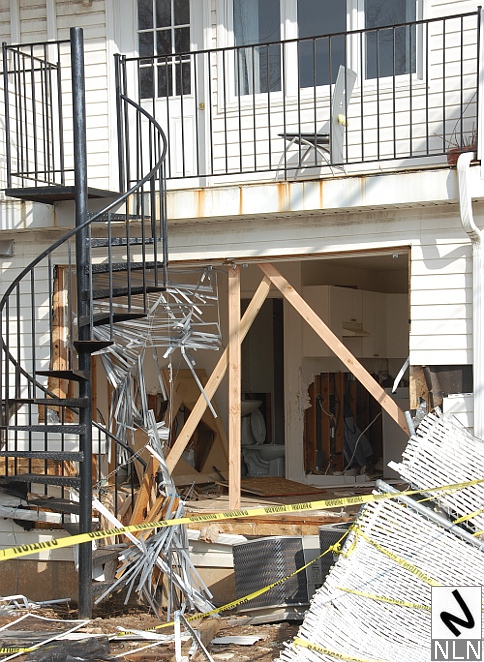
In South Beach: a home missing an exterior wall.
(Photo: Thomas Altfather Good / NLN)

 
“My son and daughter contacted FEMA, and my flood insurance and home owners’ insurance company, State Farm, two days after the storm. All paperwork was filled out and completed by day four. It is now January 2 and we still have not heard a word from anyone,” DeSanno told NLN.


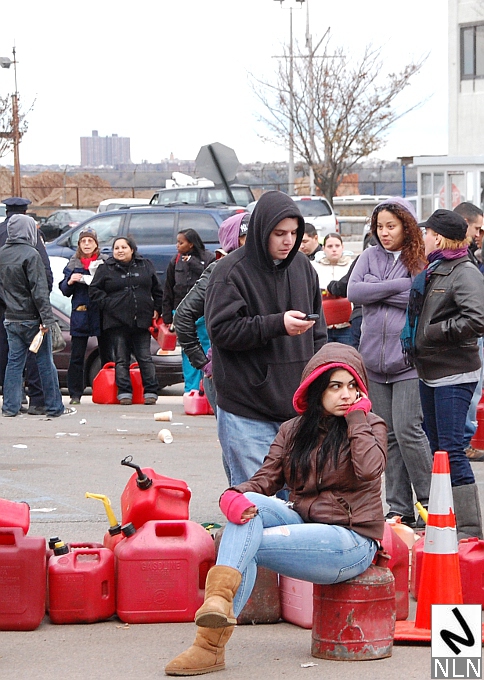
Staten Islanders on line to get gas for their generators.
(Photo: Thomas Altfather Good / NLN)

 
“My son Anthony suffered second and third degree burns on both arms the week after the storm — bringing a pot of boiling water to the upstairs bathroom so I could take a hot bath. He fell with the pot. He lost his job and did not have any medical coverage. One of the nurses told us that FEMA should be able to help with the medical bills as his injury was related to the storm. No word from FEMA on that issue either,” DeSanno said.

 
Adding to the misery was the threat of looters.

 
“There was looting in the first week or so. My daughter was followed into the back yard by a man who looked like he was a drug addict. It was around 5:00 pm, just getting dark and she was coming home from work. My son saw her and came out of the house and questioned the man. He made up a story and left the property. I’m not sure about my neighbors [experiences]. Many of them have not come back to the block yet.

 
DeSanno’s insurance company has indicated they will not cover any possessions that were destroyed when the first floor flooded — because the apartment was in a “basement” area. This issue was never raised during the years the company collected premiums.


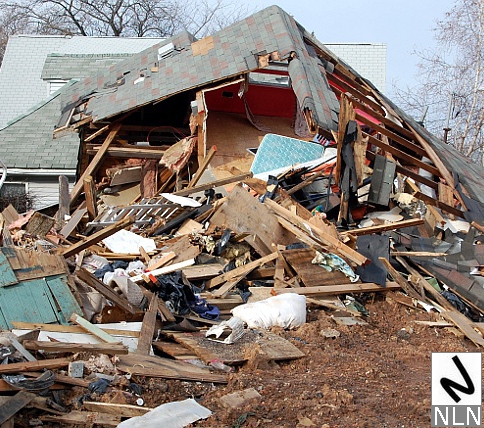
A house on Quincy Avenue — its foundation is on the other side of the street.
(Photo: Thomas Altfather Good / NLN)

 
The DeSanno’s are not alone. Many Islanders have had insurance claims denied primarily because most hurricane insurance only covers wind damage, not storm surge. In addition insurance companies have argued that if a policy lists any “excluded peril” and the damage suffered is a mix that includes any such exclusion (“multiple causation”) then the claim can legally be denied. Once a victim is denied by their insurance company they may be eligible for a lower interest FEMA loan, usually 1.688 percent to 4.0 percent. But only after they are denied a bank loan — whose interest rates range from 3.375 to 6 percent.


A large sinkhole outside South Beach Psychiatric Center.
(Photo: Thomas Altfather Good / NLN)

 
Many homeowners who have been denied by their insurance carriers are faced with a choice: foreclosure or taking on more debt. A high interest loan and a mortgage on a home that has lost most of its value is a distressing prospect. In addition, FEMA home loans are capped at $200,000 and the agency requires collateral.


A pile of shingles on Cedar Grove Avenue in New Dorp Beach.
(Photo: Thomas Altfather Good / NLN)

 
As a result of community members not being able to get viable assistance, some neighborhoods resemble ghost towns. Some homeowners have simply walked away from their shattered homes, being unable or unwilling to take on crippling debt. Those who do return have no way of knowing if the house next door will ever be reoccupied. The official death count on Staten Island, with Midland Beach being hit the hardest, is 23. But many more people are simply not accounted for — their whereabouts are unknown. High interest loans, devalued properties, and missing neighbors weigh heavily on the minds of those who choose to rebuild.


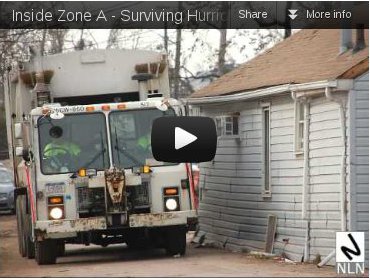
Click HERE to see “Inside Zone A” (Video)

 
Addressing her fellow survivors at the December 15 speakout, Midland Beach resident Simona Safari was visibly upset. Speaking about the issue of having to pay interest on FEMA loans she asked, “Why [do] the state and government have to make money on us?”

 
Adding to the cost of rebuilding, Safari said that the City will not re-evaluate property values before calculating next year’s property taxes, despite the fact that many homes are now worth a fraction of their pre-disaster value and the homeowners are being forced to take on additional debt. Safari blasted the Mayor who has been silent on this and other issues.


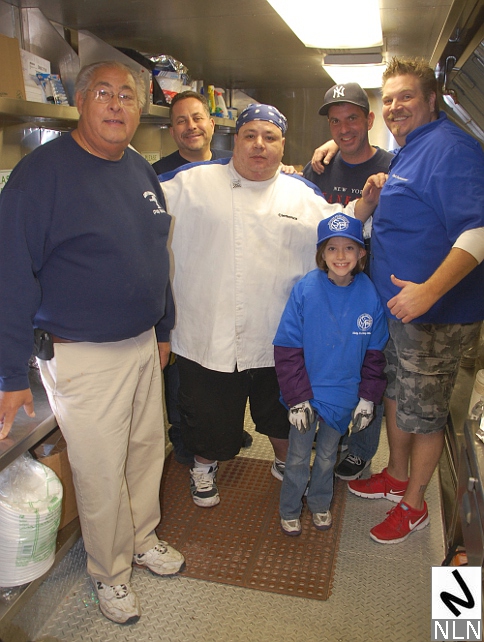
Celebrity chefs Clemenza (center) and Burmeister (right) serving free food in Midland Beach.
(Photo: Thomas Altfather Good / NLN)

 
“Our mayor is again preoccupied with the issue of sodium intake. And how much soda we drink. Where is he?” she asked.

 
In a report entitled “Shouldering the Debt,” an Occupy Wall Street “offshoot” called Strike Debt pointed out that, “The focus on lending moves money from the victims of disaster into the hands of loan servicers who make $1 billion in profit annually off of these loans,”

 
Things aren’t much better for small business owners. Small Business Administration loan applications are 30 pages long — and many Sandy victims report that their personal papers, including documentation required by the SBA, were destroyed by flood waters.


Sam Cocozza in his New Dorp Beach home.
(Photo: Thomas Altfather Good / NLN)

 
RETURN TO NORMAL?

 
Sam Cocozza lives in New Dorp Beach. During the storm his basement filled with water and the tidal surge left a foot of water in his family’s living space.

 
Cocozza’s in-laws lived a few streets closer to the water and their home also flooded. Like many families in the area, they had wanted to ride the storm out in order to protect their property but the tidal surge washed away those hopes. Many of the residents of New Dorp Beach, including Sam and his extended family, ran — or swam — for their lives as the surge pushed a wall of water into their community, filling the streets and their homes in a matter of minutes. Wanting to escape together, Sam tried to get to his inlaws’ house to pick them up — but the water was moving too fast. He found them later, safe but soaked and shivering. They were shaken but they had survived.


Cedar Grove Avenue — a few blocks away from Cocozza’s home.
(Photo: Thomas Altfather Good / NLN)

 
Around midnight the tide receded somewhat and rescues began — many residents of New Dorp Beach were trapped in their attics or on rooftops. The survivors found themselves wet, weary, and homeless. After basic survival needs were addressed thoughts of rebuilding began to emerge. But recovery would be a very long process.

 
As a Verizon employee, Cocozza worked long shifts restoring communications for storm victims, even though his own home was flooded.


A Verizon worker on the job in Stapleton.
(Photo: Thomas Altfather Good / NLN)

 
“We were forced [ to work ] twelve hour days, to restore other peoples’ service. Telephone poles were down so peoples’ tv and internet services were out, telephone lines were down, so yeah we were forced to work 12 hours days. At least for the first four or five weeks after the storm hit.

 
In the affected areas you had a lot of people that were still living there and they wanted their tv and internet back, it was important to them. But I had a feeling that almost all of the fixes were temporary. We’re obviously going to be back there once their construction is done. It was more, seemed to be like, making people feel better — more than an actual fix.

 
We had worked on one block where the gentleman was almost shell shocked. He was glad to see us repair his services but he mentioned that there was four dead people on the block. In general there were some shell shocked people. It was tough. It was tough seeing devastation after devastation. And there were different degrees of devastation. By me in New Dorp Beach, we thought it was pretty wrecked but then as you go down to areas closer to the water, you see — it gets worse. There are different levels of devastation, I would say, from bad to worse. There were several blocks, I worked in Oakwood Beach and Midland Beach, and two times people told me that there were two or three people dead on the block.”


Click HERE to see Sam’s home (Video)

 
Cocozza applied for New York City’s “Rapid Repairs” program.

 
“The Rapid Repairs I’m going through now, and it is slow. The time between the electrician comes and the boiler guy comes, it’s slow but all things considered…” he said.


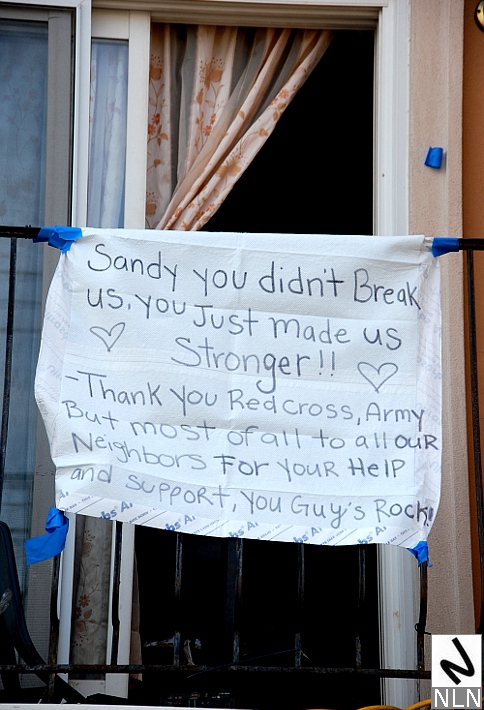
Survivors on Sand Lane (South Beach) express their gratitude to all who helped.
(Photo: Thomas Altfather Good / NLN)

 
Cocozza said that the Red Cross was on the disaster scene relatively quickly but their activities were limited to distributing food, and the food didn’t compare to what local businesses were offering. Local pizzerias stepped up, in true New York fashion, delivering pizza to people who were sticking it out in their homes.

 
“It was almost like, ‘no thanks Red Cross, there’s pizza behind you.’ Or a college kid walking along with a shopping cart full of Subway sandwiches,” Cocozza said.

 
Sam doesn’t expect a quick fix, even with “Rapid Repairs.”

 
“There’s a long way to go. About 50 percent of the people have moved back in. While the lower floors are being repaired they’re living on the upper floors,” Cocozza said.


As with Hession and Governale, mold remediation is a big concern for Cocozza who not only worries for his neighbors’ well being but also has to work in their homes, homes that could be filled with black mold.

 
“People are putting sheetrock back up without doing any of that [ remediation ],” he said. Cocozza paid a service to dehumidify his home and to use anti-microbial spray to kill the mold – trying to do remediation the right way – but not everyone has the resources to pay for remediation. The net result is that people are using bleach, vinegar and even anti-freeze to try to kill the mold. Cocozza points out that the FEMA website states clearly that bleach WILL kill the mold on smooth surfaces. But wooden beams are not smooth. And so the mold may return.

 
While his home is drying out and being slowly brought back online Cocozza continues to work in the field, encountering other hazards. Although it took a little prodding, Verizon management did eventually provide masks and rubber gloves. Then Cocozza, a CWA steward, had to educate his coworkers that they needed to be safe.

 
Sheetrock dust, asbestos, mold and other airborne toxins make masks essential. And gloves protect workers from all that the storm waters carried into the victims’ homes.


“There’s sewage all over all the equipment we’re touching,” Cocozza said.

 
For Sam, his coworkers, and his fellow Staten Islanders, it will be a very long time before anything resembling normalcy returns to their lives.


Clifton, Staten Island.
(Photo: Thomas Altfather Good / NLN)

 
EPILOG

 
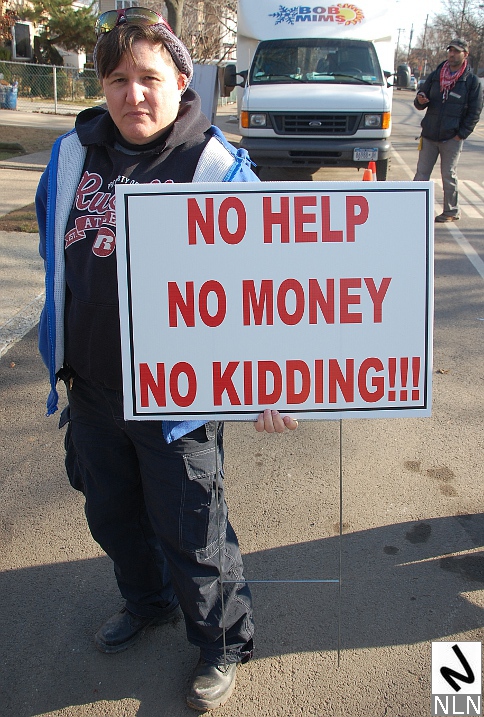
Although it is something of a cliche to refer to Staten Island as “The Forgotten Borough,” it remains by and large an accurate description — at least in the minds of its residents. FEMA took over five days to arrive on Staten Island; the Red Cross was late getting to Midland Beach — and when they arrived all they had to offer was poor quality food; and Rapid Repairs is, by most accounts, anything but. The Mayor’s response has been criticized by survivors, the Congress has been brutally slow in providing aid, and the only politician to take action on the mold crisis is Public Advocate Bill de Blasio. The voices of the forgotten borough are crying out for help as they struggle to rebuild. Is anyone listening?


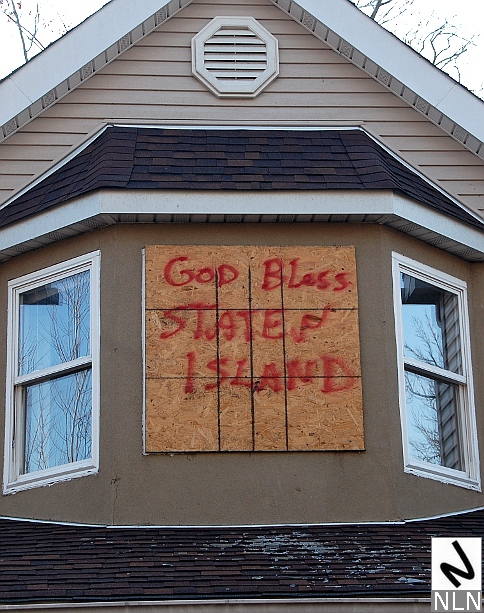
“God Bless Staten Island…”
(Photo: Thomas Altfather Good / NLN)

 
Thank you to Angela DeSanno, Mike Dimino, Sam Cocozza and all of the First (and Second) Responders who are helping others while rebuilding their own lives. — Thomas Altfather Good, West Brighton, Staten Island.


Click To View Photos and Videos…


Categories
News and Views

NYC Winter Road Maintenance – A Request

Dear Mayor Mamdani and Members of the City Council,

I am writing to urge the City of New York to reconsider the current practice of assigning road maintenance and de-icing responsibilities to the Department of Sanitation, and to advocate for the creation of a dedicated public works or street maintenance department, similar to the model used successfully in cities such as Buffalo.

While DSNY performs an essential and demanding role in keeping the city clean, sanitation work and road maintenance are fundamentally different functions. Combining them has led to significant operational inefficiencies, unnecessary costs, and avoidable damage to infrastructure, vehicles, and public health.

In particular, DSNY’s current salting practices create several persistent problems:

• Salt spreader trucks routinely continue dispensing salt while stopped at traffic lights, resulting in large accumulations at intersections that serve no safety purpose and accelerate corrosion of vehicles and roadway surfaces.

• On one-way streets, snow and salt are consistently pushed to one side, concentrating damage on parked vehicles. In my own case, this contributed directly to premature brake rotor failure and a damaged ABS sensor, repairs that are both costly and common among city drivers.

• After snow events, DSNY street sweepers are not deployed in a timely manner to remove excess salt and debris, allowing corrosive material to remain on roadways for weeks.

Excessive salt use has broad consequences: damage to citizens’ vehicles, accelerated deterioration of roads and bridges, increased maintenance costs, contamination of soil and waterways, and respiratory impacts on residents. Airborne salt dust on dry days following snow events affects pedestrians and cyclists directly and exacerbates respiratory conditions such as asthma, while contributing to the corrosion of nearby infrastructure and vehicles.

There is also a fiscal concern. Snow operations require extensive overtime from sanitation staff, often at premium rates, even though road maintenance is not their primary function. A dedicated public works department, staffed and equipped specifically for roadway operations, would allow for more precise salt application, better post-storm cleanup, reduced overtime expenses, and longer service life for city infrastructure.

Such a dedicated public works initiative would also create meaningful employment opportunities, providing specialized positions in road maintenance, winter operations, and infrastructure management. This would both enhance operational expertise and contribute positively to the local economy.

New York City is large, complex, and deserving of specialized departments that can perform their missions efficiently and responsibly. Separating sanitation from road maintenance would align responsibility with expertise and ultimately save money while improving quality of life for residents.

I respectfully ask that the City Council and the Mayor’s Office study this issue and consider pilot programs or structural changes that move roadway maintenance out of DSNY and into a dedicated public works framework.

Thank you for your time and consideration.

Sincerely,
Thomas Altfather Good

Categories
News and Views

Cycle Therapy


Motorcycling is a stress reliever, one I call Cycle Therapy. To view my biker clips on YouTube click this link:

Riding The Storm Out

Ride Safe.